Ancient Grain Spotlight
Rajgira (Amaranth) - The Ancient Grain Built for the Future
"An ancient supergrain that has nourished civilizations for thousands of years."

Long before the world embraced superfoods, ancient civilizations cultivated grains that naturally delivered exceptional nutrition, resilience, and sustained nourishment.
One such extraordinary grain is Rajgira (Amaranth).
Known as the "King of Grains" in many Indian traditions, Rajgira has been cultivated for over 8,000 years. Revered by the Aztecs in Central America and deeply rooted in Indian culinary traditions, this remarkable pseudocereal is celebrated for its exceptional nutritional profile and remarkable adaptability.
Far more than a fasting ingredient, Rajgira is increasingly recognized worldwide as one of the most nutrient-dense ancient grains, combining high-quality plant protein with essential minerals, dietary fiber, and naturally occurring bioactive compounds.
Far more than a fasting ingredient, Rajgira is increasingly recognized worldwide as one of the most nutrient-dense ancient grains, combining high-quality plant protein with essential minerals, dietary fiber, and naturally occurring bioactive compounds.
Today, nutrition scientists continue to study Amaranth for its role in sustainable agriculture, functional nutrition, and future food security.
What Makes Rajgira Remarkable?
✓ Naturally gluten-free
✓ Exceptionally rich in high-quality plant protein
✓ Contains all nine essential amino acids, including lysine
✓ Rich in dietary fiber
✓ Excellent source of calcium, iron and magnesium
✓ Naturally contains antioxidants and bioactive compounds
✓ Supports sustained energy when paired with nuts and seeds
✓ Easy to digest and highly versatile
✓ Thrives under drought-prone and challenging growing conditions
History & Origin
Rajgira is believed to have originated in Central and South America, where it was domesticated more than 8,000 years ago. It formed one of the principal crops of the ancient Aztec civilization, valued for both its nutritional richness and cultural significance.
Independent species of amaranth have also been cultivated across Asia and Africa for centuries. In India, Rajgira became an important traditional grain due to its resilience, nutritional value, and suitability during religious fasting.
Over generations, Indian communities embraced Rajgira in laddoos, chikkis, rotis, porridges, and festive foods, making it an integral part of traditional diets.
🌍 Where Is It Grown Today?
Global Production
• India • China • Nepal • Mexico •Peru • United States • Kenya • Ethiopia
Major Indian States
• Maharashtra • Karnataka • Uttar Pradesh • Madhya Pradesh • Rajasthan • Gujarat• Tamil Nadu • Telangana
Rajgira grows well in warm climates and demonstrates remarkable adaptability to drought, poor soils, and low-input farming systems, making it an increasingly valuable crop in sustainable agriculture.
Nutritional Highlights
Complete Plant Protein - Unlike most cereal grains, Rajgira provides all nine essential amino acids, making it one of the few plant foods with a complete protein profile.
Dietary Fiber - Supports digestive health, promotes satiety, and contributes to balanced nutrition.
Calcium - Among the richest plant-based grain sources of calcium, supporting healthy bones and teeth.
Iron - Supports healthy red blood cell formation and oxygen transport throughout the body.
Magnesium - Contributes to muscle function, energy metabolism, and normal nervous system function.
Potassium - Helps maintain normal muscle function and fluid balance.
Antioxidants & Polyphenols - Naturally occurring compounds that help protect cells from oxidative stress.
Squalene & Bioactive Compounds - Rajgira naturally contains unique plant compounds that continue to attract interest in nutrition research.
🔬 Why Scientists Are Excited
Researchers continue to investigate Rajgira for its:
• Exceptional protein quality
• Complete essential amino acid profile
• High mineral density
• Dietary fiber
• Bioactive peptides
• Antioxidant compounds
• Gluten-free functionality
• Climate resilience
• Drought tolerance
• Potential role in future sustainable food systems
Its combination of nutritional excellence and environmental adaptability makes Rajgira one of the world's most promising ancient grains.
🌱 Why It Matters for the Future
Modern agriculture faces growing challenges from climate change, water scarcity, and increasing demand for nutritious foods.
Rajgira addresses many of these challenges by requiring relatively low agricultural inputs while producing highly nutritious seeds rich in protein, minerals, and dietary fiber.
Its resilience under difficult growing conditions makes it an increasingly important crop for climate-smart agriculture and global food security.
As consumers seek minimally processed, whole-food nutrition, Rajgira is once again gaining recognition as a grain for the future.
Traditional Uses
Rajgira has been enjoyed for centuries in a wide variety of traditional recipes:
• Rajgira Laddoos • Chikki • Rajgira Roti • Puri • Porridge • Kheer • Flour for fasting recipes • Energy bars • Breakfast cereals • Modern healthy snacks
Its mild, nutty flavour and excellent nutritional value make it equally suitable for traditional cooking and innovative functional foods.
💡 Did You Know?
Rajgira is technically not a true cereal grain. It is classified as a pseudocereal, similar to quinoa, yet nutritionally rivals many conventional grains with its exceptional protein and mineral content.
The word "Amaranth" comes from the Greek word amarantos, meaning "everlasting" or "unfading"—a fitting name for a crop that has nourished civilizations for thousands of years.
Why Rajgira Matters Today
Rajgira beautifully demonstrates how ancient foods can provide modern nutritional solutions.
Its unique combination of complete protein, dietary fiber, essential minerals, digestibility, and climate resilience makes it one of today's most valuable functional grains.
At Millvana, we believe innovation is not always about creating something new.
Sometimes, it is about rediscovering the remarkable foods that generations before us trusted for nourishment and vitality.
That's why Rajgira forms an important part of our thoughtfully crafted millet-based products, where this extraordinary ancient grain is combined with premium whole-food ingredients to create balanced nutrition for modern lifestyles.
Because the future of healthy eating often begins by rediscovering the wisdom of the past.
Ancient Grain Spotlight: Ragi (Finger Millet)
"The tiny grain with extraordinary strength—nourishing generations, naturally."

Long before calcium supplements, protein powders, and fortified foods became common, traditional communities relied on nutrient-rich grains that naturally supported strength, endurance, and overall well-being.
One such exceptional grain is Ragi (Finger Millet).
Cultivated for more than 5,000 years, Ragi is one of the oldest cereal grains known to humankind. Revered across India and Africa, it has long been valued for its remarkable nutritional density, resilience, and ability to thrive in challenging climates.
Today, Ragi is celebrated as one of the most nutritious millets, recognized for its naturally high calcium content, dietary fiber, essential amino acids, and abundant antioxidants. Its impressive nutritional profile has renewed scientific interest, making it a key grain for healthier diets and sustainable agriculture.
What Makes Ragi Remarkable?
✓ Naturally gluten-free
✓ One of the richest plant sources of calcium among cereal grains
✓ Rich in dietary fiber for digestive wellness
✓ Good source of plant-based protein
✓ Contains iron, magnesium, phosphorus and potassium
✓ Rich in natural antioxidants and polyphenols
✓ Contains essential amino acids including methionine
✓ Supports steady energy release due to its complex carbohydrates
✓ Highly resilient to drought and poor soil conditions
History & Origin
Ragi is believed to have originated in the highlands of East Africa, particularly present-day Ethiopia and Uganda, over 5,000 years ago. From there, it spread to the Indian subcontinent through ancient trade routes, where it became deeply integrated into traditional agriculture and regional cuisines.
For centuries, Ragi has been cultivated across southern and central India, where it became a staple food for farming communities due to its exceptional nutritional value, long storage life, and resilience to harsh environmental conditions.
Today, it remains one of India's most important traditional millets and continues to gain international recognition as a climate-smart supergrain.
🌍 Where Is It Grown Today?
Global Production
• India Nepal • Ethiopia • Uganda • Kenya • Tanzania • Sri Lanka • Bhutan
Major Indian States
• Karnataka (largest producer) • Tamil Nadu • Andhra Pradesh • Telangana • Odisha • Maharashtra • Uttarakhand • Chhattisgarh
Ragi thrives in dryland farming systems and hilly terrains, producing reliable harvests even under low rainfall and minimal agricultural inputs.
Nutritional Highlights
Calcium - Ragi is among the richest natural plant sources of calcium, supporting healthy bones, teeth, muscle function, and overall skeletal health.
Dietary Fiber - Promotes digestive wellness, supports gut health, enhances satiety, and contributes to sustained energy.
Plant Protein - Provides essential amino acids that help support muscle maintenance and overall nutrition.
Iron - Supports healthy hemoglobin formation and normal oxygen transport throughout the body.
Magnesium - Essential for muscle function, nerve transmission, and energy metabolism.
Phosphorus - Contributes to strong bones, healthy teeth, and cellular energy production.
Potassium - Supports normal muscle function and helps maintain electrolyte balance.
Polyphenols & Antioxidants - Naturally occurring plant compounds that help protect cells from oxidative stress and contribute to overall wellness.
🔬 Why Scientists Are Excited
Researchers continue to study Ragi for its:
• Exceptional calcium content
• High dietary fiber
• Resistant starch
• Essential amino acids
• Antioxidant-rich polyphenols
• Low to moderate glycemic response
• Gluten-free nutritional profile
• Climate resilience
• Efficient water use
• Potential role in sustainable food systems
Scientific interest continues to grow as Ragi offers both nutritional excellence and environmental sustainability.
🌱 Why It Matters for the Future
As climate change, soil degradation, and water scarcity challenge conventional agriculture, resilient crops like Ragi are becoming increasingly important.
Ragi requires significantly less water than many major cereal crops, performs well under rainfed conditions, and grows successfully in nutrient-poor soils.
Its combination of environmental resilience and outstanding nutritional quality makes it an ideal crop for climate-smart agriculture, dietary diversification, and future food security.
The revival of Ragi reflects a growing appreciation for traditional grains that promote both human health and planetary well-being.
Traditional Uses
For generations, Ragi has been enjoyed in a wide variety of traditional and modern dishes:
• Ragi Roti • Ragi Mudde • Ragi Dosa • Ragi Idli • Ragi Porridge • Ragi Malt • Ragi Upma • Ragi Cookies • Ragi Laddoos • Healthy baked snacks and breakfast cereals Its naturally earthy flavour and versatility make it suitable for both traditional recipes and innovative functional foods.
💡 Did You Know?
Ragi contains more natural calcium than most commonly consumed cereal grains, making it one of the world's most nutritionally valuable traditional grains.
Its tiny seeds can be safely stored for many years without significant loss of quality, making Ragi an important grain for long-term food security.
Why Ragi Matters Today
Ragi is a remarkable example of how ancient grains continue to provide solutions for modern nutritional and environmental challenges.
Its rich mineral profile, dietary fiber, plant protein, digestibility, and resilience make it one of the most valuable grains for today's health-conscious consumers.
At Millvana, we believe innovation is not always about creating something new.
Sometimes, it is about rediscovering the timeless wisdom of traditional foods that have nourished generations.
That's why Ragi forms an important part of our thoughtfully crafted millet-based products, where wholesome ancient grains meet carefully selected natural ingredients to create balanced nutrition for modern lifestyles.
Because the strongest foundations for a healthier future are often built on the wisdom of the past.
Ancient Grain Spotlight: Jowar (Sorghum)
"An ancient grain that has nourished civilizations for millennia—naturally wholesome, resilient, and remarkably versatile."

Long before "superfoods" became a trend, Jowar was nourishing civilizations across Africa and Asia.
Today, this remarkable ancient grain is making a well-deserved comeback—not because it's new, but because its nutritional value and sustainability have stood the test of time.
For thousands of years, Jowar has been a staple in traditional diets. Naturally resilient to drought and requiring significantly less water than many conventional cereals, it has supported farming communities across challenging climates while providing wholesome nourishment.
Today, Jowar is celebrated not only for its naturally gluten-free composition but also for its rich content of dietary fiber, plant protein, essential minerals, antioxidants, and slowly digestible carbohydrates. As consumers increasingly seek wholesome, sustainable foods, this ancient grain is experiencing a remarkable global revival.
What Makes Jowar Exceptional?
✓ Naturally gluten-free
✓ Rich source of dietary fiber
✓ Good source of plant-based protein
✓ Contains iron, magnesium and phosphorus
✓ Rich in antioxidants and polyphenols
✓ Supports sustained energy release
✓ Naturally low in saturated fat
✓ Excellent source of complex carbohydrates
✓ Highly drought-resistant and climate resilient
✓ Supports sustainable agriculture with lower water requirements
History & Origin
Jowar is believed to have originated in the northeastern regions of Africa, particularly present-day Ethiopia and Sudan, where archaeological evidence suggests it was domesticated nearly 8,000 years ago.
From Africa, Jowar spread through ancient trade routes into India, the Middle East, and Asia, becoming one of the earliest cereal crops cultivated by farming communities.
India embraced Jowar centuries ago, integrating it de eply into regional cuisines and agricultural systems. Its resilience against drought and high temperatures made it an indispensable crop in semi-arid regions, where it continues to support millions of farmers today.
Recognized globally as one of the most climate-resilient cereal grains, Jowar is increasingly valued for both nutritional security and sustainable farming.
🌍 Where Is It Grown Today?
Global Production
• India • United States • Nigeria • Sudan • Ethiopia • Mexico • Australia • Argentina • China
Major Indian States
• Maharashtra (largest producer) • Karnataka • Telangana • Madhya Pradesh • Rajasthan • Gujarat • Tamil Nadu • Andhra Pradesh
Jowar performs exceptionally well in hot, dry climates and requires considerably less water than many conventional cereal crops, making it an ideal grain for future climate-resilient agriculture.
Nutritional Highlights
Dietary Fiber - Jowar is naturally rich in dietary fiber, supporting digestive health, promoting satiety, and contributing to balanced nutrition.
Plant Protein - Provides quality plant-based protein that supports muscle maintenance and overall nutritional well-being.
Iron - Contributes to normal red blood cell formation and healthy oxygen transport throughout the body.
Magnesium - Supports muscle function, nerve transmission, heart health, and energy metabolism.
Phosphorus - Essential for healthy bones, teeth, and efficient cellular energy production.
Potassium - Helps maintain fluid balance, supports normal muscle function, and contributes to cardiovascular health.
Antioxidants & Polyphenols - Jowar contains naturally occurring bioactive compounds that help protect cells against oxidative stress and support overall wellness.
Complex Carbohydrates - Its slowly digestible carbohydrates provide sustained energy, making Jowar an excellent grain for active lifestyles.
🔬 Why Scientists Are Excited
Modern nutritional research continues to highlight Jowar for its:
• High dietary fiber content
• Naturally gluten-free composition
• Rich antioxidant profile
• Slowly digestible starch
• Beneficial polyphenols
• Essential minerals
• Plant-based protein
• Potential support for glycemic management
• Gut health benefits
• Climate-smart agricultural potential
Researchers also recognize Jowar as one of the world's most environmentally sustainable cereal crops, capable of maintaining productivity under water-limited conditions.
🌱 Why It Matters for the Future
Agriculture today faces increasing challenges from climate change, water scarcity, and soil degradation.
Jowar offers an effective solution through its exceptional adaptability. It thrives with significantly lower water requirements than many staple cereals, tolerates prolonged drought, and grows successfully in marginal soils where other crops often struggle.
Its resilience, combined with impressive nutritional value, positions Jowar as a key grain for sustainable food systems, climate-resilient farming, and future global food security.
Reviving ancient grains like Jowar not only preserves agricultural biodiversity but also supports healthier and more sustainable diets.
Traditional Uses
Across generations, Jowar has been prepared in numerous traditional and contemporary recipes:
• Jowar Bhakri • Jowar Roti • Jowar Dosa • Jowar Idli • Jowar Upma • Jowar Khichdi • Porridge • Breakfast cereals • Energy bars • Healthy cookies • Baked snacks
• Millet flour blends
Its mild flavour and versatile texture make it suitable for both traditional Indian cuisine and innovative functional foods.
💡 Did You Know?
Jowar ranks among the top five most important cereal crops in the world, feeding hundreds of millions of people across diverse climates.
Its naturally pigmented varieties—including red, black, and purple sorghum—contain especially high levels of beneficial antioxidants, making them subjects of growing nutritional research.
Why Jowar Matters Today
Jowar perfectly illustrates how ancient grains continue to address modern nutritional and environmental needs.
Its combination of dietary fiber, plant protein, essential minerals, antioxidants, and climate resilience makes it one of the most valuable whole grains for contemporary lifestyles.
At Millvana, we believe the future of nutrition lies in rediscovering nature's timeless wisdom.
That's why Jowar plays an important role in our thoughtfully crafted millet-based products, where ancient grains meet carefully selected natural ingredients to create wholesome, balanced nutrition for today's families.
Because sustainable health begins with grains that nourish both people and the planet.
Ancient Grain Spotlight: Bajra (Pearl Millet)
sustainable health begins with grains that nourish both people and the planet.
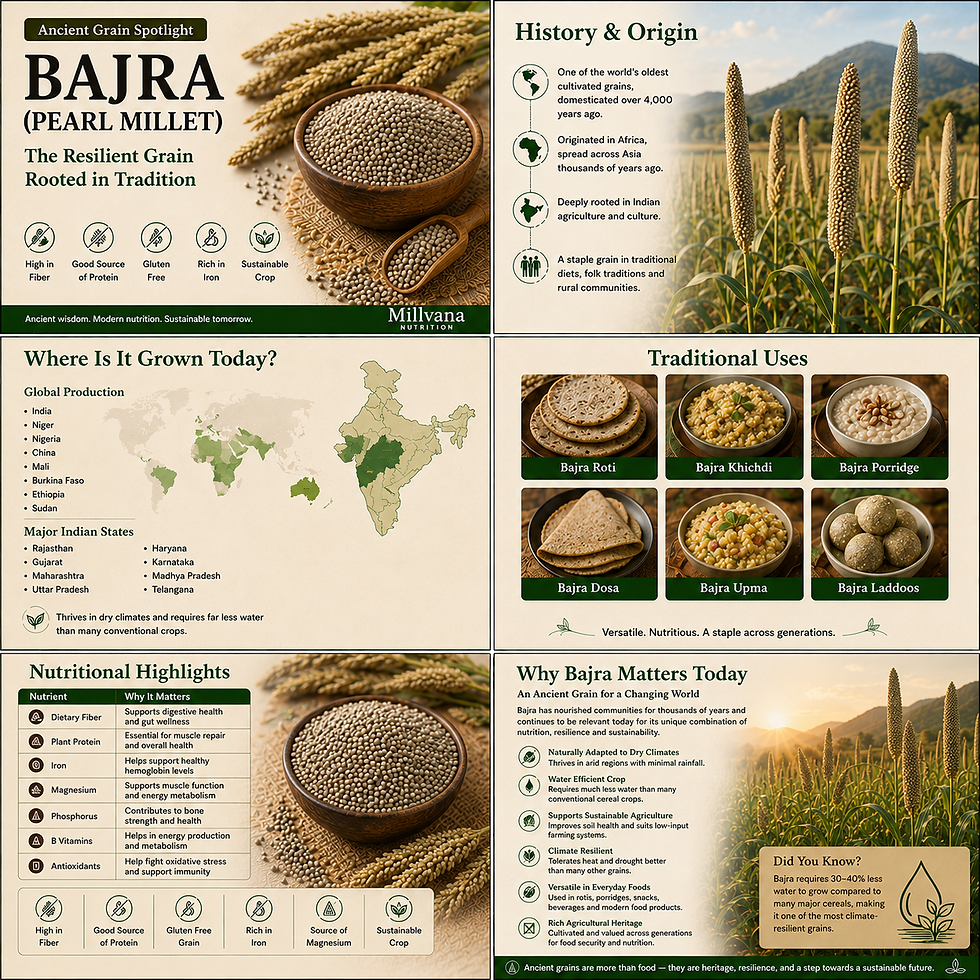
Long before the world embraced superfoods, ancient civilizations cultivated grains that naturally delivered exceptional nutrition, resilience, and sustained nourishment.
One such remarkable grain is Bajra (Pearl Millet).
Cultivated for more than 4,000 years, Bajra is among the world's oldest and most climate-resilient cereal grains. Widely grown across Africa and the Indian subcontinent, it has sustained generations living in some of the harshest environments on Earth.
Far more than a traditional staple, Bajra is now recognized globally for its impressive nutritional profile. Rich in dietary fiber, plant-based protein, essential minerals, antioxidants, and slowly digestible carbohydrates, it is increasingly valued as a nutritious whole grain for modern lifestyles.
Today, researchers continue to study Pearl Millet for its contribution to sustainable agriculture, functional nutrition, and future food security.
What Makes Bajra Remarkable?
✓ Naturally gluten-free
✓ Rich source of dietary fiber
✓ Good source of plant-based protein
✓ Excellent source of iron, magnesium and phosphorus
✓ Contains potassium and zinc
✓ Naturally rich in antioxidants and polyphenols
✓ Provides slowly digestible complex carbohydrates
✓ Supports sustained energy release
✓ Thrives under drought, heat and water-scarce conditions
✓ Supports climate-resilient and sustainable agriculture
History & Origin
Bajra is believed to have originated in the Sahel region of West Africa more than 4,000 years ago, where it was domesticated as one of the earliest cereal crops capable of thriving in hot, arid climates.
Over centuries, Pearl Millet spread across Africa, the Middle East and the Indian subcontinent through ancient trade routes. India embraced Bajra as an important staple grain, particularly in regions experiencing high temperatures and limited rainfall.
Its remarkable ability to flourish in difficult growing conditions made it indispensable for farming communities, and it remains one of India's most important traditional cereal crops today.
As global agriculture faces increasing environmental challenges, Bajra is gaining renewed recognition as one of the world's most climate-resilient grains.
🌍 Where Is It Grown Today?
Global Production
• India • Nigeria • Niger • Sudan • Mali • Burkina Faso • Senegal • Chad • China
Major Indian States
• Rajasthan • Uttar Pradesh • Maharashtra • Gujarat • Haryana • Karnataka • Madhya Pradesh • Telangana • Tamil Nadu
Bajra performs exceptionally well under hot, dry conditions and requires significantly less water than many conventional cereal crops. Its resilience makes it an important crop for sustainable agriculture and future food security.
Nutritional Highlights
Dietary Fiber — Naturally rich in dietary fiber, supporting digestive health, satiety and balanced nutrition.
Plant Protein — Provides quality plant-based protein that supports muscle maintenance and overall well-being.
Iron — Contributes to healthy red blood cell formation and normal oxygen transport throughout the body.
Magnesium — Supports muscle function, nerve transmission, heart health and energy metabolism.
Phosphorus — Essential for healthy bones, teeth and efficient cellular energy production.
Potassium — Helps maintain normal muscle function and supports fluid balance.
Zinc — Supports immune function and contributes to normal cell growth and repair.
Antioxidants & Polyphenols — Naturally occurring compounds that help protect cells against oxidative stress.
Complex Carbohydrates — Slowly digestible carbohydrates provide sustained energy, making Bajra suitable for active lifestyles.
🔬 Why Scientists Are Excited
Modern nutritional research continues to highlight Bajra for its:
• High dietary fiber content
• Naturally gluten-free composition
• Rich mineral profile
• Slowly digestible starch
• Antioxidant compounds
• Plant-based protein
• Beneficial polyphenols
• Potential support for glycemic management
• Gut health benefits
• Exceptional drought tolerance
Researchers also recognize Pearl Millet as one of the world's most climate-smart cereal crops because of its ability to maintain productivity under extreme heat and water-limited conditions.
🌱 Why It Matters for the Future
Agriculture today faces increasing challenges from climate change, declining water availability and soil degradation.
Bajra offers a practical solution through its remarkable adaptability. It grows successfully with significantly lower water requirements than many staple cereals, tolerates prolonged drought and performs well in nutrient-poor soils where other crops often struggle.
Its combination of nutritional richness and environmental resilience makes Pearl Millet an increasingly important grain for sustainable food systems, climate-smart agriculture and future global food security.
Rediscovering ancient grains like Bajra helps preserve agricultural biodiversity while supporting healthier diets and more sustainable farming practices.
Traditional Uses
Across generations, Bajra has been prepared in numerous traditional and contemporary recipes:
• Bajra Roti • Bhakri • Khichdi • Porridge • Dosa • Idli • Upma • Millet Flour Blends • Breakfast Cereals • Energy Bars • Healthy Cookies • Baked Snacks
Its earthy flavour and hearty texture make Bajra equally suitable for traditional Indian cuisine and innovative whole-food products.
💡 Did You Know?
Pearl Millet is among the world's most drought-tolerant cereal crops and can produce nutritious harvests in regions receiving as little as 250–300 mm of annual rainfall, where many other grains struggle to survive.
Its exceptional resilience has made it one of the most important crops supporting food security across arid and semi-arid regions for thousands of years.
Why Bajra Matters Today
Bajra perfectly demonstrates how ancient grains continue to provide solutions to modern nutritional and environmental challenges.
Its combination of dietary fiber, plant protein, essential minerals, antioxidants and outstanding climate resilience makes it one of today's most valuable whole grains.
At Millvana Nutrition, we believe the future of nutrition lies in rediscovering nature's timeless wisdom.
That's why Bajra forms an important part of our thoughtfully crafted millet-based products, where this remarkable ancient grain is combined with carefully selected whole-food ingredients to create balanced nutrition for modern lifestyles.
Because sustainable health begins with grains that nourish both people and the planet.
Ancient Grain Spotlight: Barnyard Millet (Sanwa / Samak / Japanese Barnyard Millet)
sustainable health begins with grains that nourish both people and the planet.

Long before the world embraced superfoods, ancient civilizations cultivated grains that naturally delivered exceptional nutrition, resilience, and sustained nourishment.
One such remarkable grain is Barnyard Millet.
Cultivated for thousands of years across Asia, Barnyard Millet is one of the fastest-growing and most resilient ancient millets. Traditionally consumed in India during fasting (vrat) and valued throughout East Asia for its adaptability, this humble grain is now gaining worldwide recognition for its impressive nutritional profile and sustainability.
Far more than a traditional fasting grain, Barnyard Millet is celebrated for its naturally gluten-free composition, high dietary fiber, essential minerals, slowly digestible carbohydrates, and relatively low glycaemic impact compared with many refined cereal foods. Its versatility and environmental resilience make it one of the most promising grains for modern healthy eating.
Today, nutrition scientists and agricultural researchers continue to study Barnyard Millet for its role in functional nutrition, sustainable agriculture, and future food security.
What Makes Barnyard Millet Remarkable?
✓ Naturally gluten-free
✓ Rich source of dietary fiber
✓ Good source of plant-based protein
✓ Naturally rich in iron and phosphorus
✓ Contains magnesium and potassium
✓ Naturally low in fat
✓ Provides slowly digestible complex carbohydrates
✓ Rich in naturally occurring antioxidants and polyphenols
✓ Fast-growing crop with a short growing season
✓ Highly drought-tolerant and climate resilient
✓ Requires relatively low agricultural inputs
History & Origin
Barnyard Millet belongs to the Echinochloa family and has been cultivated in Asia for several thousand years. Historical evidence suggests that different species were independently domesticated across India, China, Japan, and parts of Southeast Asia, where they became valuable food crops because of their rapid growth and ability to thrive under difficult environmental conditions.
In India, Barnyard Millet has long been associated with traditional fasting foods and rural agriculture. Known by names such as Sanwa, Samak, Bhagar, Moriyo, and Oodalu in different regions, it has remained an important grain in traditional Indian cuisine for generations.
Today, Barnyard Millet is experiencing a global revival as consumers rediscover ancient grains that combine excellent nutrition with environmental sustainability.
🌍 Where Is It Grown Today?
Global Production
• India • China • Japan • Nepal • South Korea • Pakistan • Sri Lanka • Thailand
Major Indian States
• Uttarakhand • Uttar Pradesh • Maharashtra • Karnataka • Tamil Nadu • Andhra Pradesh • Telangana • Chhattisgarh • Odisha
Barnyard Millet grows exceptionally well in rain-fed and marginal farming systems. Its short crop cycle—often around 45 to 70 days, depending on the variety and climate—allows farmers to cultivate it successfully even in regions with limited rainfall.
Nutritional Highlights
Dietary Fiber — Naturally rich in dietary fiber, supporting digestive health, satiety, and balanced nutrition.
Plant Protein — Provides quality plant-based protein that contributes to muscle maintenance and overall nutritional well-being.
Iron — Barnyard Millet is among the better natural millet sources of iron, contributing to normal red blood cell formation and oxygen transport.
Magnesium — Supports muscle function, nerve transmission, heart health, and energy metabolism.
Phosphorus — Essential for healthy bones, teeth, and efficient cellular energy production.
Potassium — Helps maintain normal muscle function and fluid balance.
Complex Carbohydrates — Slowly digestible carbohydrates help provide sustained energy throughout the day.
Antioxidants & Polyphenols — Naturally occurring plant compounds that help protect cells against oxidative stress.
Naturally Low in Fat — Makes Barnyard Millet suitable for a wide range of balanced dietary patterns.
🔬 Why Scientists Are Excited
Modern nutritional research continues to highlight Barnyard Millet for its:
• High dietary fiber content
• Naturally gluten-free composition
• Rich mineral profile
• Slowly digestible starch
• Naturally occurring antioxidants
• Beneficial polyphenols
• Plant-based protein
• Potential support for glycaemic management as part of a healthy diet
• Gut health benefits
• Climate-smart agricultural potential
Researchers are also studying Barnyard Millet because its short growing cycle, resilience to drought, and relatively low resource requirements make it an increasingly valuable crop for sustainable food systems.
🌱 Why It Matters for the Future
Agriculture today faces increasing challenges from climate change, declining water resources, and the need to nourish a growing global population.
Barnyard Millet offers an effective solution through its remarkable adaptability. It matures quickly, performs well under rain-fed conditions, requires relatively fewer agricultural inputs than many staple cereals, and grows successfully in marginal soils where other crops often struggle.
Its combination of nutritional value, resilience, and efficient resource use positions Barnyard Millet as one of the most promising grains for climate-smart agriculture and future food security.
Rediscovering ancient grains like Barnyard Millet helps preserve agricultural biodiversity while supporting healthier diets and more sustainable farming systems.
Traditional Uses
Across generations, Barnyard Millet has been enjoyed in numerous traditional and contemporary recipes:
• Upma • Khichdi • Dosa • Idli • Pongal • Porridge • Vrat Khichdi • Pulao • Millet Flour Blends • Energy Bars • Healthy Cookies • Breakfast Cereals • Modern Functional Foods
Its mild flavour, light texture, and versatility make Barnyard Millet suitable for both traditional Indian cuisine and innovative whole-food products.
💡 Did You Know?
Barnyard Millet is one of the fastest-growing cereal crops in the world, with many varieties reaching harvest in as little as 45–60 days under favourable conditions.
Its naturally light texture, quick cooking time, and excellent adaptability have made it an important food crop in mountain regions and drought-prone farming systems for centuries.
Why Barnyard Millet Matters Today
Barnyard Millet beautifully demonstrates how ancient grains continue to provide solutions for modern nutritional and environmental challenges.
Its combination of dietary fiber, plant-based protein, essential minerals, naturally occurring antioxidants, and exceptional climate resilience makes it one of today's most valuable whole grains.
At Millvana Nutrition, we believe the future of nutrition lies in rediscovering nature's timeless wisdom.
That's why Barnyard Millet forms an important part of our thoughtfully crafted millet-based products, where this extraordinary ancient grain is combined with carefully selected natural ingredients to create balanced nutrition for modern lifestyles.
Because sustainable health begins with grains that nourish both people and the planet.
Ancient Grain Spotlight: Foxtail Millet (Kangni / Kakum / Thinai / Korra)
sustainable health begins with grains that nourish both people and the planet.

Long before the world embraced superfoods, ancient civilizations cultivated grains that naturally delivered exceptional nutrition, resilience, and sustained nourishment.
One such remarkable grain is Foxtail Millet.
Cultivated for over 8,000 years, Foxtail Millet is one of the oldest domesticated cereal grains in human history. Archaeological discoveries identify it among the earliest crops cultivated in ancient China, from where it spread across Asia and eventually became deeply integrated into traditional Indian agriculture and cuisine.
Far more than a traditional millet, Foxtail Millet is increasingly recognized worldwide for its balanced nutritional profile. Naturally gluten-free, rich in dietary fiber, plant-based protein, essential minerals, antioxidants, and slowly digestible complex carbohydrates, it is becoming a preferred whole grain for health-conscious consumers seeking nutritious and sustainable foods.
Today, nutrition scientists continue to study Foxtail Millet for its role in functional nutrition, climate-smart agriculture, and future global food security.
What Makes Foxtail Millet Remarkable?
✓ Naturally gluten-free
✓ Rich source of dietary fiber
✓ Good source of plant-based protein
✓ Rich in iron, magnesium and phosphorus
✓ Contains potassium and B-complex vitamins
✓ Naturally rich in antioxidants and polyphenols
✓ Provides slowly digestible complex carbohydrates
✓ Naturally low in saturated fat
✓ Excellent source of sustained energy
✓ Highly drought-tolerant and climate resilient
✓ Requires relatively low water and agricultural inputs
History & Origin
Foxtail Millet (Setaria italica) is believed to have originated in Northern China, where archaeological evidence indicates it was domesticated nearly 8,000 years ago. It was among the earliest cereal crops cultivated by ancient farming communities and played a vital role in the development of early civilizations across East Asia.
Over time, Foxtail Millet spread through trade and migration into India, Central Asia, Europe, and parts of Africa. In India, it became an important traditional grain, known by different regional names such as Thinai (Tamil), Korra (Telugu), Navane (Kannada), Kangni (Hindi), and Kakum (Marathi).
Its adaptability to dry climates and poor soils allowed farming communities to cultivate nutritious food even in challenging environments.
Today, Foxtail Millet is experiencing a global revival as consumers rediscover ancient grains that combine excellent nutrition with environmental sustainability.
🌍 Where Is It Grown Today?
Global Production
• India • China • Nepal • Mongolia • Russia • Ukraine • South Korea • Japan
Major Indian States
• Karnataka • Andhra Pradesh • Telangana • Tamil Nadu • Maharashtra • Odisha • Chhattisgarh • Madhya Pradesh • Uttar Pradesh
Foxtail Millet performs exceptionally well in semi-arid regions and requires considerably less water than many conventional cereal crops. Its resilience makes it an important crop for sustainable farming and climate-smart agriculture.
Nutritional Highlights
Dietary Fiber — Naturally rich in dietary fiber, supporting digestive health, satiety, and balanced nutrition.
Plant Protein — Provides quality plant-based protein that contributes to muscle maintenance and overall nutritional well-being.
Iron — Supports normal red blood cell formation and healthy oxygen transport throughout the body.
Magnesium — Contributes to muscle function, nerve transmission, heart health, and energy metabolism.
Phosphorus — Essential for healthy bones, teeth, and efficient cellular energy production.
Potassium — Helps maintain fluid balance and supports normal muscle function.
B-Complex Vitamins — Naturally contains several B vitamins that contribute to normal energy-yielding metabolism.
Antioxidants & Polyphenols — Naturally occurring plant compounds that help protect cells against oxidative stress.
Complex Carbohydrates — Slowly digestible carbohydrates provide sustained energy, making Foxtail Millet suitable for active lifestyles.
🔬 Why Scientists Are Excited
Modern nutritional research continues to highlight Foxtail Millet for its:
• High dietary fiber content
• Naturally gluten-free composition
• Rich mineral profile
• Slowly digestible starch
• Beneficial polyphenols
• Antioxidant compounds
• Plant-based protein
• Potential support for glycaemic management as part of a balanced diet
• Gut health benefits
• Climate-smart agricultural potential
Researchers also recognize Foxtail Millet as an important crop for sustainable food systems because it thrives with relatively low water requirements while maintaining reliable productivity under challenging climatic conditions.
🌱 Why It Matters for the Future
Agriculture today faces increasing challenges from climate change, declining freshwater resources, and the need to feed a growing global population sustainably.
Foxtail Millet offers a practical solution through its remarkable adaptability. It grows successfully in semi-arid regions, requires significantly less water than many staple cereals, and performs well in marginal soils with relatively low agricultural inputs.
Its nutritional richness, combined with environmental resilience, positions Foxtail Millet as one of the most promising grains for climate-smart agriculture and future food security.
Rediscovering ancient grains like Foxtail Millet helps preserve agricultural biodiversity while supporting healthier diets and more sustainable farming systems.
Traditional Uses
Across generations, Foxtail Millet has been prepared in numerous traditional and contemporary recipes:
• Foxtail Millet Upma • Idli • Dosa • Pongal • Khichdi • Pulao • Porridge • Millet Flour Blends • Breakfast Cereals • Energy Bars • Healthy Cookies • Baked Snacks
Its mild flavour and versatile texture make Foxtail Millet suitable for both traditional Indian cuisine and innovative functional foods.
💡 Did You Know?
Foxtail Millet is one of the oldest cultivated cereal crops in the world, with archaeological evidence tracing its cultivation back nearly 8,000 years. It played a significant role in the diets of some of humanity's earliest farming communities and continues to support millions of people across Asia today.
Its short growing season and exceptional adaptability make it one of the most dependable cereal crops in regions facing water scarcity and unpredictable climates.
Why Foxtail Millet Matters Today
Foxtail Millet perfectly demonstrates how ancient grains continue to provide solutions for modern nutritional and environmental challenges.
Its combination of dietary fiber, plant-based protein, essential minerals, antioxidants, slowly digestible carbohydrates, and remarkable climate resilience makes it one of today's most valuable whole grains.
At Millvana Nutrition, we believe the future of nutrition lies in rediscovering nature's timeless wisdom.
Because sustainable health begins with grains that nourish both people and the planet.
Ancient Grain Spotlight: Little Millet (Kutki / Sama / Saamai / Savan)
sometimes the smallest grains leave the greatest legacy—for our health, our farmers, and our planet.

Great things often come in small packages. Little Millet may be one of the smallest grains in the millet family, yet it has nourished farming communities for thousands of years with remarkable resilience and nutritional richness.
The future of nutrition may not lie in discovering new foods—it may lie in rediscovering the ancient grains that quietly nourished civilizations for thousands of years.
Among these timeless treasures is Little Millet, one of the oldest cultivated grains known to humankind.
Small in size yet remarkably rich in nutrition, Little Millet has sustained communities across the Indian subcontinent for over 4,000 years. Traditionally valued for its resilience, digestibility and ability to thrive in challenging environments, it is now gaining global recognition as a wholesome grain perfectly suited for modern lifestyles.
Far more than a forgotten millet, Little Millet is celebrated for its naturally gluten-free composition, rich dietary fibre, plant-based protein, essential minerals, antioxidants and slowly digestible complex carbohydrates. As consumers increasingly seek clean, sustainable and minimally processed foods, this ancient grain is experiencing a remarkable revival.
Today, nutrition scientists continue to study Little Millet for its role in sustainable agriculture, functional nutrition and future food security.
What Makes Little Millet Remarkable?
✓ Naturally gluten-free
✓ Rich source of dietary fibre
✓ Good source of plant-based protein
✓ Contains iron, magnesium and phosphorus
✓ Naturally rich in antioxidants and polyphenols
✓ Provides slowly digestible complex carbohydrates
✓ Supports sustained energy release
✓ Easy to digest and versatile in cooking
✓ Thrives under drought-prone and low-input farming conditions
✓ Supports climate-smart and sustainable agriculture
History & Origin
Little Millet is believed to have originated in the Indian subcontinent and parts of Southeast Asia, where it has been cultivated for more than 4,000 years. It has long been one of India's traditional small millets, valued for its nutritional richness and ability to grow successfully under difficult environmental conditions.
For generations, farming communities cultivated Little Millet because it required relatively little water, matured quickly and adapted well to poor soils. It became an integral part of traditional Indian diets, prepared in porridges, rotis, rice alternatives and festive dishes.
Today, Little Millet is being rediscovered as an important ancient grain that combines nutritional excellence with environmental sustainability.
🌍 Where Is It Grown Today?
Global Production
• India • Nepal • Sri Lanka • Myanmar • China • Ethiopia
Major Indian States
• Karnataka • Tamil Nadu • Andhra Pradesh • Telangana • Odisha • Chhattisgarh • Madhya Pradesh • Maharashtra
Little Millet performs exceptionally well in dryland farming systems and requires considerably less water than many conventional cereal crops, making it an important grain for sustainable agriculture.
Nutritional Highlights
Dietary Fibre — Naturally rich in dietary fibre that supports digestive health, promotes satiety and contributes to balanced nutrition.
Plant Protein — Provides quality plant-based protein that supports muscle maintenance and overall nutritional well-being.
Iron — Contributes to healthy red blood cell formation and normal oxygen transport.
Magnesium — Supports muscle function, nerve health, heart health and energy metabolism.
Phosphorus — Essential for healthy bones, teeth and efficient cellular energy production.
B Vitamins — Naturally contains several B vitamins that support normal energy metabolism.
Antioxidants & Polyphenols — Naturally occurring compounds that help protect cells against oxidative stress.
Complex Carbohydrates — Slowly digestible carbohydrates provide sustained energy, making Little Millet ideal for active lifestyles.
🔬 Why Scientists Are Excited
Modern nutritional research continues to highlight Little Millet for its:
• High dietary fibre content
• Naturally gluten-free composition
• Rich antioxidant profile
• Slowly digestible starch
• Beneficial polyphenols
• Essential minerals
• Plant-based protein
• Potential support for glycemic management
• Gut health benefits
• Climate-smart agricultural potential
'
Researchers also recognize Little Millet as one of the important traditional crops capable of contributing to sustainable food systems because of its adaptability to water-limited environments.
🌱 Why It Matters for the Future
As climate change, water scarcity and soil degradation increasingly challenge agriculture, resilient crops like Little Millet are becoming more important than ever.
This ancient grain thrives with relatively low water requirements, performs well in marginal soils and supports sustainable farming with minimal agricultural inputs.
Its combination of nutritional richness, environmental resilience and farming adaptability positions Little Millet as one of the grains that can contribute meaningfully to future food security.
Rediscovering traditional millets like Little Millet helps preserve biodiversity while encouraging healthier, more sustainable diets for generations to come.
Traditional Uses
Across generations, Little Millet has been prepared in numerous traditional and contemporary recipes:
• Little Millet Rice • Khichdi • Upma • Pongal • Dosa • Idli • Porridge • Millet Flour Blends • Breakfast Cereals • Energy Bars • Healthy Cookies • Baked Snacks
Its mild flavour and light texture make it an excellent alternative to rice while also lending itself beautifully to innovative whole-food products.
💡 Did You Know?
Despite its tiny size, Little Millet is one of the most nutrient-dense traditional millets and has been cultivated in India for thousands of years using remarkably little water compared to many conventional cereal crops.
Its naturally small grains mature quickly, making it an important crop for farmers in regions with uncertain rainfall.
Why Little Millet Matters Today
Little Millet reminds us that the smallest grains often carry the greatest wisdom.
Its combination of dietary fibre, plant-based protein, essential minerals, antioxidants and exceptional climate resilience makes it one of the most valuable ancient grains for modern nutrition.
At Millvana Nutrition, we believe true innovation begins by respecting nature's wisdom rather than replacing it.
That's why Little Millet plays an important role in our thoughtfully crafted millet-based products, where ancient grains are combined with carefully selected whole-food ingredients to create balanced nutrition for today's families.
Because the healthiest future is built on the timeless grains that have nourished humanity for generations—and Little Millet is one of nature's finest gifts to both people and the planet.
Ancient Grain Spotlight: Proso Millet (Chena / Common Millet)
when we rediscover ancient grains like Proso Millet, we don't simply honour our agricultural heritage—we invest in a healthier, more sustainable future for generations to come.

Some of the world's greatest nutritional treasures have been quietly growing for thousands of years, waiting to be rediscovered. Among them is Proso Millet—an ancient grain whose remarkable resilience and wholesome nutrition make it as relevant today as it was to the earliest farming civilizations.
Cultivated for more than 7,000 years, Proso Millet (Panicum miliaceum) is one of the oldest domesticated cereal grains in human history. Known by different names across cultures, it has nourished communities from Asia and Europe to the Indian subcontinent for millennia.
Far more than a traditional grain, Proso Millet is increasingly recognized worldwide for its naturally gluten-free composition, balanced nutrition, plant-based protein, dietary fiber, essential minerals and exceptional environmental sustainability. As consumers seek wholesome foods that are good for both people and the planet, this ancient grain is enjoying a well-deserved revival.
Today, nutrition scientists continue to study Proso Millet for its role in sustainable agriculture, functional nutrition and future global food security.
What Makes Proso Millet Remarkable?
✓ Naturally gluten-free
✓ Rich source of dietary fibre
✓ Good source of plant-based protein
✓ Contains iron, magnesium and phosphorus
✓ Naturally provides B vitamins
✓ Rich in antioxidants and beneficial plant compounds
✓ Provides slowly digestible complex carbohydrates
✓ Naturally low in saturated fat
✓ Thrives under drought-prone and water-limited conditions
✓ Supports climate-smart and sustainable agriculture
History & Origin
Proso Millet is believed to have originated in northern China and Central Asia, where archaeological evidence suggests it was cultivated more than 7,000 years ago. It was among the earliest cereal crops domesticated by ancient farming communities because of its short growing season and remarkable adaptability.
Over time, Proso Millet spread across Europe, the Middle East and the Indian subcontinent through trade and migration, becoming an important grain in regions with limited rainfall and challenging climates.
In India, Proso Millet has been cultivated for generations, particularly in dryland farming regions, where its resilience and dependable yields have made it an important traditional crop.
Today, it is increasingly recognized as a valuable grain for sustainable agriculture and diversified food systems.
🌍 Where Is It Grown Today?
Global Production
• China • India • Russia • Ukraine • Kazakhstan • United States • Nepal • Mongolia
Major Indian States
• Karnataka • Andhra Pradesh • Telangana • Tamil Nadu • Maharashtra • Madhya Pradesh • Chhattisgarh • Odisha
Proso Millet grows exceptionally well in dry climates and requires considerably less water than many conventional cereal crops. Its short growing cycle and low agricultural input requirements make it an increasingly important grain for sustainable farming.
Nutritional Highlights
Dietary Fibre — Naturally rich in dietary fibre that supports digestive health, promotes satiety and contributes to balanced nutrition.
Plant Protein — Provides quality plant-based protein that supports muscle maintenance and overall nutritional well-being.
Iron — Contributes to healthy red blood cell formation and normal oxygen transport.
Magnesium — Supports muscle function, heart health, nerve function and energy metabolism.
Phosphorus — Essential for healthy bones, teeth and efficient cellular energy production.
B Vitamins — Naturally contains several B vitamins that support normal energy metabolism.
Antioxidants & Plant Compounds — Naturally occurring compounds that help protect cells from oxidative stress.
Complex Carbohydrates — Slowly digestible carbohydrates provide sustained energy, making Proso Millet suitable for active lifestyles.
🔬 Why Scientists Are Excited
Modern nutritional research continues to highlight Proso Millet for its:
• High dietary fibre content
• Naturally gluten-free composition
• Rich mineral profile
• Slowly digestible starch
• Beneficial antioxidants
• Plant-based protein
• B-vitamin content
• Potential support for glycemic management
• Gut health benefits
• Climate-smart agricultural potential
Researchers also recognize Proso Millet for its efficient use of water, short cultivation period and ability to produce nutritious harvests under challenging environmental conditions.
🌱 Why It Matters for the Future
Agriculture today faces mounting challenges from climate change, water scarcity and the need to feed a growing global population.
Proso Millet offers an effective solution through its remarkable adaptability. It matures quickly, performs well with relatively little rainfall and requires fewer agricultural inputs than many conventional cereal crops.
Its combination of nutritional value, environmental resilience and farming efficiency positions Proso Millet as an important grain for sustainable food systems and future food security.
Rediscovering ancient grains like Proso Millet not only preserves agricultural biodiversity but also supports healthier diets and more resilient farming communities.
Traditional Uses
Across generations, Proso Millet has been prepared in numerous traditional and contemporary recipes:
• Millet Rice • Khichdi • Upma • Porridge • Dosa • Idli • Pulao • Millet Flour Blends • Breakfast Cereals • Energy Bars • Healthy Cookies • Baked Snacks
Its mild flavour and light texture make it an excellent rice alternative while also serving as an ideal ingredient for innovative whole-food products.
💡 Did You Know?
Proso Millet is one of the fastest-growing cereal crops in the world, with some varieties reaching harvest in as little as 60–90 days. This rapid growth, combined with low water requirements, makes it an important crop for regions facing uncertain rainfall and changing climate conditions.
Why Proso Millet Matters Today
Proso Millet reminds us that some of humanity's oldest crops may hold the answers to tomorrow's greatest nutritional and environmental challenges.
Its combination of dietary fibre, plant-based protein, essential minerals, antioxidants and exceptional climate resilience makes it one of the most valuable ancient grains for modern living.
At Millvana Nutrition, we believe the future of healthy eating is built upon the wisdom of traditional foods.
Because when we rediscover ancient grains like Proso Millet, we don't simply honour our agricultural heritage—we invest in a healthier, more sustainable future for generations to come.
Ancient Grain Spotlight: Quinoa
Revered by the ancient Inca civilization as the "Mother Grain,"
